NAC for Skin Health: What the Evidence Says Before You Add It to Your Routine
NAC is marketed for antioxidant and glutathione support, but its role in skin health is more limited and nuanced than many product claims suggest. This guide explains the evidence, risks, product types, marketing strategies, and decision points to consider before adding NAC to a skincare or supplement routine.
14 min read
NAC is not nonsense, but it is not a proven skin shortcut
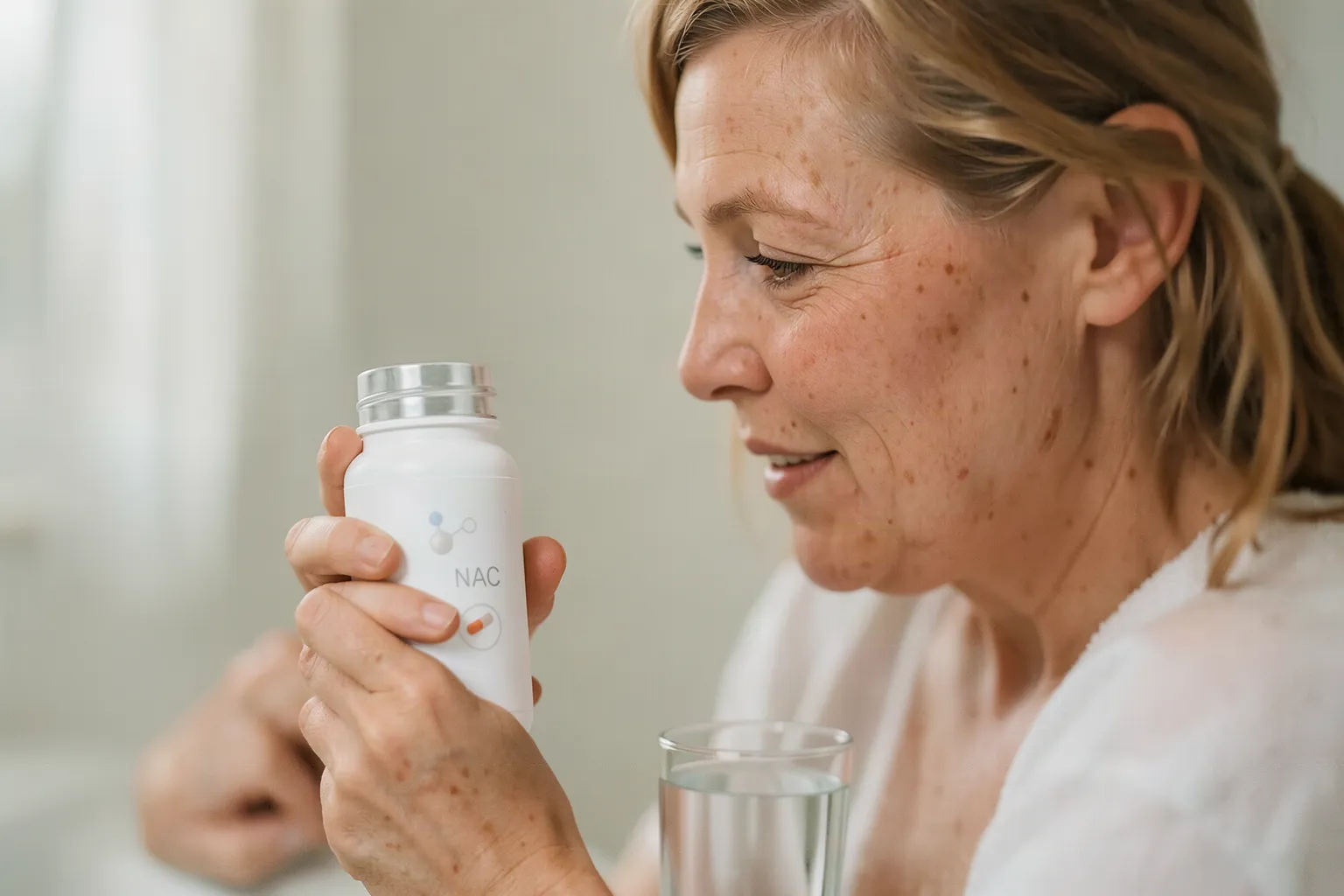
You may notice NAC in a glutathione-support supplement, a liver or detox formula, a respiratory wellness product, or a beauty-from-within blend and wonder whether it could change your skin.
NAC has real medical and biochemical relevance. It is not just a wellness buzzword. But that does not mean an over-the-counter NAC supplement is a proven way to get clearer, brighter, younger-looking, or healthier skin.
For most people, the evidence for visible skin benefits is limited, indirect, or specific to certain clinical contexts. NAC is marketed around antioxidants, glutathione support, detox language, respiratory wellness, immune support, cellular health, longevity, and sometimes skin radiance. The practical bottom line is calmer: NAC may be worth discussing in select situations, especially when a concern overlaps with clinician-guided care. It should not replace sunscreen, barrier-supportive skincare, condition-specific treatment, or a medical evaluation when one is needed.
What is NAC?
NAC stands for N-acetylcysteine. It is a form of the amino-acid-related compound cysteine, which is involved in the body’s glutathione biology.[1]
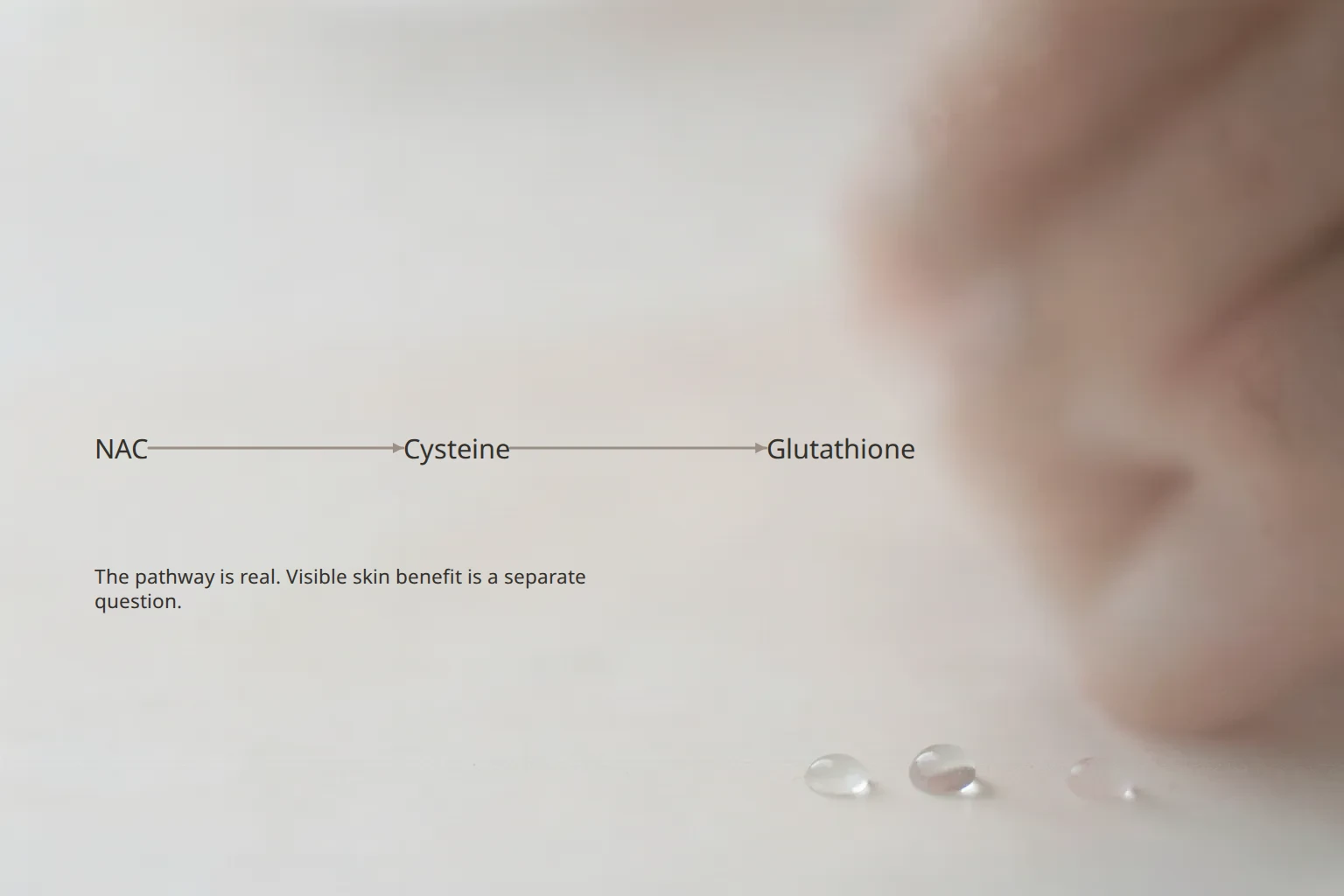
Glutathione is one of the body’s important antioxidant systems. That connection is the reason many NAC products use language such as “antioxidant support,” “glutathione support,” or “cellular health.”
The jump from that biology to visible skin improvement is where the evidence becomes much less certain. A pathway can be relevant without proving that a supplement changes what you see in the mirror.
It also matters which NAC context you mean. Acetylcysteine has medical uses. NAC is also sold as a dietary supplement. Some products may use NAC or acetylcysteine-related language in skin-adjacent or cosmetic contexts. Those categories are not interchangeable.
How NAC is used: medicine, supplements, and skin-adjacent products
NAC appears in several different settings, and the setting changes what you can responsibly conclude from the label.
In medicine, acetylcysteine has established uses under clinician direction. That medical identity is one reason the ingredient can feel more serious than many supplements. Still, a medical use in one context does not prove that an over-the-counter supplement improves skin health for everyday cosmetic goals.
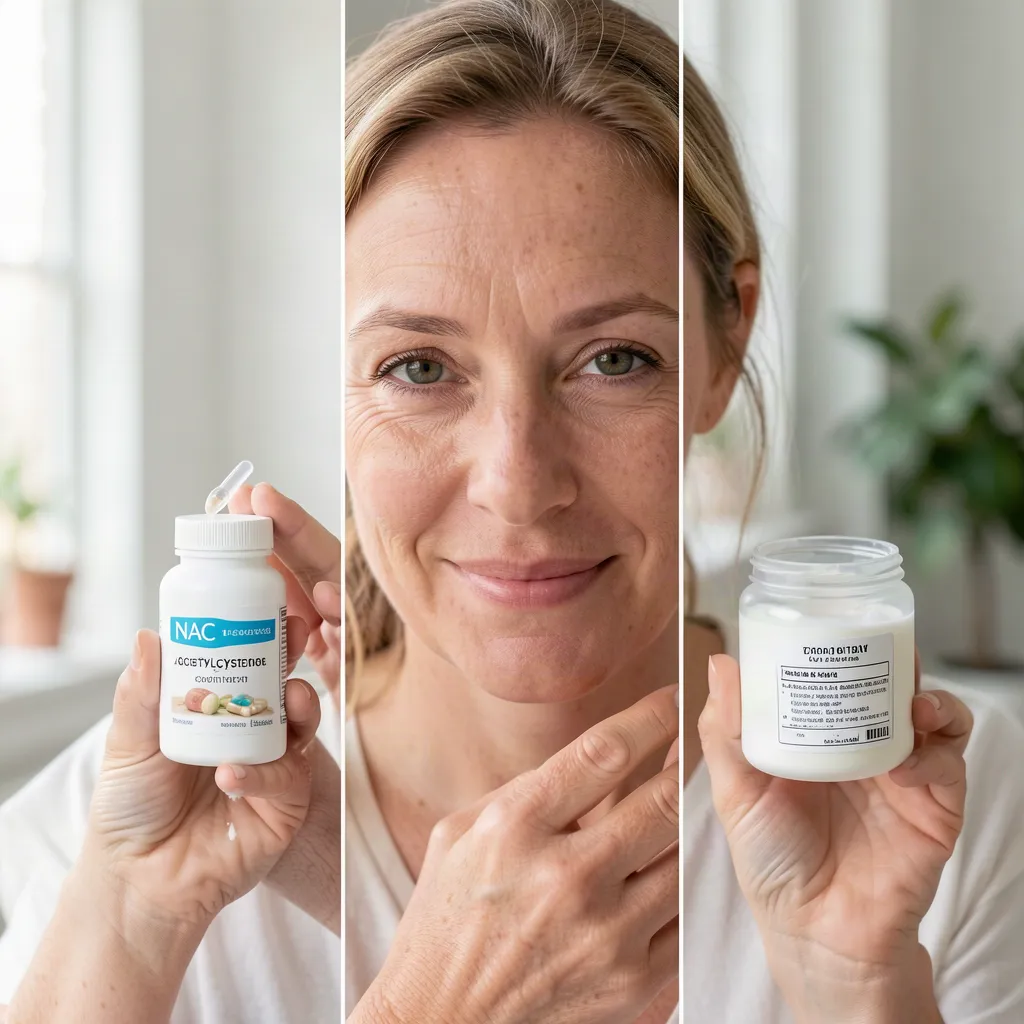
In supplements, NAC may be sold as capsules, tablets, powders, effervescent products, or combination formulas. Combination products may pair NAC with ingredients marketed for antioxidant, liver, immune, respiratory, cellular-health, or glutathione-support positioning, such as vitamin C, selenium, glycine, alpha-lipoic acid, milk thistle, or other wellness ingredients.
Topical or cosmetic products containing NAC or acetylcysteine appear less commonly than oral supplements. If you see it on a skincare label, read the full ingredient list and the product claims carefully. A topical cosmetic product, an oral supplement, and a prescription or hospital-use medication should not be treated as the same thing.
Why NAC is linked to skin claims
NAC is linked to skin claims because oxidative stress and inflammation are relevant to many skin conversations. The skin is exposed to ultraviolet light, pollution, irritation, infection, hormones, immune signals, and wound-healing demands. Antioxidant pathways can matter in those processes.
NAC is also discussed because it can contribute to cysteine availability, and cysteine is connected to glutathione.[1] In simple terms, brands often position NAC as a way to support an internal antioxidant system.
That is biologically plausible. It is not the same as proof that taking NAC will make your skin look better.
This is where marketing can get ahead of the evidence. A supplement can sound scientific because the pathway is real, even when the promised skin outcome has not been shown clearly in people like you, using the product you are considering, for the goal you actually care about.
Evidence-confidence snapshot
Before looking at specific claims, it helps to separate evidence strength from marketing appeal.
Most specific, but still clinician-guided: NAC has been studied for body-focused repetitive behaviors such as excoriation disorder and trichotillomania. This is not the same as using NAC for general skincare, and benefits are not guaranteed.[2][3][4]
Biologically plausible but not proven for most cosmetic goals: antioxidant and glutathione-support claims. NAC may be relevant to glutathione biology, but that does not prove visible improvements in glow, texture, wrinkles, firmness, acne, pigmentation, or barrier health.
Weak or unsupported for routine beauty promises: broad claims around detoxifying the skin, radiance, anti-aging, complexion clarity, dark spots, or acne improvement should be treated cautiously unless the product provides direct human evidence for that exact outcome.

What the evidence says about NAC for skin-related concerns
The fairest way to look at NAC is not as a yes-or-no ingredient. It is more useful to ask which claim is being made, what kind of evidence supports it, and whether that evidence applies to a consumer skincare decision.
General glow, radiance, and healthy skin claims are among the weakest areas for NAC as a skin claim. NAC is often placed inside a broader beauty-from-within story, but direct evidence that it improves general glow, radiance, texture, or everyday skin quality in most people is limited. If your goal is simply healthier-looking skin, NAC should be considered optional and uncertain.
Skin aging claims also need restraint. NAC is often connected to aging-related language through antioxidant biology. Oxidative stress is part of skin aging research, and antioxidants are commonly discussed in that context. Still, antioxidant plausibility does not prove that NAC supplements visibly slow skin aging, soften lines, firm skin, or improve sun damage.
For acne, NAC may sound relevant because inflammation and oxidative stress can be part of the acne conversation. That does not make it an acne treatment. Without stronger acne-specific evidence for the product and use being discussed, NAC should not replace acne care that has clearer support, such as benzoyl peroxide, topical retinoids, azelaic acid, certain prescription treatments, or a dermatologist-guided plan.
Claims that NAC can fade dark spots, post-inflammatory hyperpigmentation, or melasma should also be treated with caution. Sunscreen remains central for many pigment concerns, and different causes of pigmentation are not managed in exactly the same way. Vague words such as clarity, tone, balance, and glow are not the same as proof.
NAC has a more specific, though still limited, evidence conversation around body-focused repetitive behaviors, including excoriation disorder and trichotillomania.[2][3][4] These are not ordinary skincare concerns. They sit at the intersection of dermatology, mental health, behavior, and sometimes medication management. NAC may help some people in these contexts, but it should not be framed as a self-directed cure for skin picking, hair pulling, nail biting, or related behaviors. If skin picking causes wounds, scarring, infection risk, distress, or a sense that you cannot stop, clinician-guided care is appropriate.
What to compare NAC with before adding it
Before adding NAC, compare it with the better-supported options for your actual goal.
For many skin concerns, the foundation is not a supplement. It is consistent sunscreen, gentle cleansing, moisturization when needed, and a routine that protects the skin barrier instead of constantly irritating it.
For acne, eczema, rosacea, melasma, wounds, infection, sudden changes, persistent rashes, or scarring, a condition-specific plan usually matters more than a general antioxidant supplement. For compulsive skin picking or related behaviors, behavioral health support and clinician-guided care may matter more than any skincare product.
If you already use sunscreen, a retinoid, vitamin C, niacinamide, benzoyl peroxide, azelaic acid, or a prescription treatment, NAC is not automatically the missing piece. It may be optional, redundant, irrelevant, or inappropriate depending on your health, medications, and reason for considering it.
Products and supplement types that contain NAC
You may see NAC in several product categories. This section describes product types, not recommendations.
The most straightforward category is single-ingredient NAC. These products are usually sold as capsules, tablets, powders, or effervescent formats. Labels may emphasize the amount of NAC per serving, but this article does not provide dosing instructions.
NAC also appears in combination supplements. These may be marketed as antioxidant blends, glutathione-support formulas, liver-support products, respiratory or immune-support formulas, longevity or cellular-health stacks, and general wellness blends.
Some formulas combine NAC with ingredients such as vitamin C, selenium, glycine, alpha-lipoic acid, milk thistle, or other compounds commonly used in wellness positioning. The presence of multiple ingredients can make the marketing feel more complete, but it can also make it harder to know what is responsible for any benefit or side effect.
You may also occasionally see NAC or acetylcysteine-related ingredients in topical or skin-adjacent products. Do not assume that a topical cosmetic product has the same evidence, absorption, safety profile, or purpose as an oral supplement or a medical acetylcysteine product.
No brand examples are included here because product labels and formulas change. If a specific product is being evaluated, its current manufacturer or retailer label should be checked directly, and any example should be presented as descriptive rather than recommended.
How NAC is positioned to consumers
NAC is usually not marketed to skin consumers in only one way. It is often positioned through a larger internal-wellness story.
The most common themes are antioxidant support, glutathione support, liver support, detox language, respiratory wellness, immune support, cellular health, longevity, clarity, radiance, balance, resilience, and healthy aging. Skin benefits may be implied rather than directly stated.
That matters because implied beauty claims can be persuasive. A label may not say “this will improve your skin,” but the surrounding language can make you feel that supporting glutathione or cellular health should translate into a visible complexion benefit.
Current quantitative marketing data, such as market size, growth rate, search volume, social-media trend data, retailer rankings, or sales figures, should be verified from current sources before numbers are attached to NAC’s popularity. Without those sources, it would be misleading to present hard figures.
What can be said cautiously is that NAC sits at the crossroads of several consumer categories: supplements with medical-adjacent credibility, antioxidant wellness, respiratory and immune support, liver and detox messaging, longevity, and beauty-from-within. That crossover is part of why it shows up in so many different product stories.
Common marketing approaches brands use for NAC products
Brands do not all market NAC the same way, but several patterns are common.
One approach is scientific-language framing. Terms such as cysteine, glutathione, oxidative stress, free radicals, mitochondria, and cellular health can make a product feel evidence-based. Sometimes that language is appropriate background; sometimes it is used to make an uncertain outcome feel more proven than it is.
Another approach is borrowed credibility. NAC’s medical identity can make supplement claims feel more established, even when the over-the-counter product is being used for a very different purpose.
A third approach is category crossover. NAC may be presented as relevant to respiratory wellness, immune support, liver support, detox routines, longevity, exercise recovery, mental clarity, or skin radiance. The more categories a product touches, the easier it is for a consumer to feel that it must be useful for something.
Ingredient bundling is also common. NAC may be paired with other antioxidants, minerals, amino acids, herbal extracts, or wellness ingredients. This can broaden the appeal, but it can also increase the number of variables if you experience a side effect or see no change.
Finally, watch for indirect beauty promises. Words such as glow, clarity, resilience, balance, and healthy aging can sound meaningful while staying hard to measure. A helpful question is: what visible or health-related outcome is this product actually promising, and what evidence supports that exact outcome?
Potential risks, side effects, and who should ask a clinician first
Over-the-counter availability does not mean risk-free. NAC may be well tolerated by some people and a poor fit for others.
Possible side effects can include gastrointestinal upset, an unpleasant sulfur smell or taste, headache, or intolerance in some people. Individual response can vary based on the product, the amount used, other ingredients in the formula, medications, and underlying health conditions.
Ask a clinician or pharmacist before using NAC if you are pregnant, trying to conceive, breastfeeding, considering it for a child or teenager, managing a chronic illness, taking multiple medications, or preparing for a procedure.
It is also especially important to ask first if you have asthma or significant respiratory disease, bleeding concerns, use anticoagulant or antiplatelet medication, use nitroglycerin, or have been told to avoid certain supplements because of your medical history.
This is not because NAC is automatically dangerous. It is because supplement decisions are not separate from the rest of your health. A pharmacist or clinician can help you check whether a product makes sense with your medications, conditions, and reason for using it.
NAC should not be used to avoid evaluation of a changing mole, infection, non-healing wound, severe acne, sudden rash, worsening pigment change, compulsive picking, or any skin concern that is persistent or distressing.
Label-reading checklist for NAC products
If you still want to evaluate a NAC product, read the label before you buy or start it.
Check whether it is single-ingredient NAC or a multi-ingredient blend.
Look for the exact amount of NAC per serving, while remembering that this article does not provide a dosing protocol.
Review every other active ingredient, especially in detox, liver, immune, respiratory, longevity, or beauty-from-within formulas.
Look for third-party testing where relevant, as well as warnings, allergens, and quality information.
Notice whether the claims are specific and measurable or mostly broad words such as detox, glow, clarity, balance, resilience, and cellular health.
Ask whether trying NAC would delay care for acne, pigmentation, wounds, infection, scarring, distressing skin picking, or another concern that deserves direct treatment.
How to decide whether NAC fits your routine
A practical NAC decision starts with the goal, not the ingredient.
Ask yourself: what am I trying to change? If the answer is general glow, vague detox, or better skin health, the evidence for NAC is not strong enough to make it a necessary step.
If the goal is acne, pigmentation, eczema, rosacea, irritation, scarring, wounds, or another specific skin concern, ask whether there is a better-supported option. In many cases, there is.
If the concern involves skin picking, hair pulling, nail biting, or a behavior that feels hard to control, treat that as a reason to seek support rather than as a simple supplement choice. NAC has been studied in some body-focused repetitive behaviors, but that conversation belongs in clinician-guided care.[2][3][4]
Then look at your personal risk context. Are you pregnant or breastfeeding? Considering this for a child? Taking medications? Managing asthma, bleeding risk, chronic illness, or an upcoming procedure? If yes, do not treat NAC as a casual skincare add-on.
Also ask whether trying NAC would delay care you already know you need. A supplement is not a good trade if it postpones treatment for a condition that is worsening, scarring, painful, or affecting your daily life.
The bottom line
NAC is a real compound with real biochemical and medical relevance. It also has a marketing life that can make its skin benefits sound more established than they are.
For most everyday skincare goals, NAC is not a proven shortcut. Sunscreen, barrier-supportive care, and condition-specific treatment usually have clearer evidence.
NAC may be reasonable to discuss in select contexts, especially when the issue overlaps with clinician-guided dermatology, medication review, or behavioral health care. Individual response varies, and the right answer depends on your health, medications, skin concern, and expectations.
If you are considering NAC as a supplement, especially for a specific skin concern, skin picking, medications, pregnancy or breastfeeding, a chronic condition, or a child, bring the product label to your dermatologist, primary care clinician, or pharmacist before starting.
References
[1] Janeczek M, Moy L, Riopelle A, Vetter O, Reserva J, Tung R, Swan J. “The Potential Uses of N-acetylcysteine in Dermatology: A Review.” Journal of Clinical and Aesthetic Dermatology. 2019;12(5):20-26. PMID 31320973. PMCID PMC6561714.
[2] Lee DK, Lipner SR. “The Potential of N-Acetylcysteine for Treatment of Trichotillomania, Excoriation Disorder, Onychophagia, and Onychotillomania: An Updated Literature Review.” International Journal of Environmental Research and Public Health. 2022;19(11):6370. DOI 10.3390/ijerph19116370. PMID 35681955. PMCID PMC9180086.
[3] Grant JE et al. “N-Acetylcysteine in the Treatment of Excoriation Disorder: A Randomized Clinical Trial.” JAMA Psychiatry. 2016;73:490-496. DOI 10.1001/jamapsychiatry.2016.0060. PMID 27007062.
[4] Grant JE et al. “N-acetylcysteine, a glutamate modulator, in the treatment of trichotillomania: A double-blind, placebo-controlled study.” Archives of General Psychiatry. 2009;66:756-763. DOI 10.1001/archgenpsychiatry.2009.60. PMID 19581567.
[Download the full guide as a PDF](https://drluriescience.netlify.app/pdf/req_conductor_n_acetylcysteine_nac_benefits_ri_ymcn47_20260904_01/fd360cf7fb0f6e3a8bedf977e9c0c4ac5aafae2819b4b8b99526697162f42b0a.pdf)